Soft Fascination [589]
Greetings from The Borders...

After a week sailing in the Med I'm back! Thanks for your patience.
If you are new here… I’m Christian Payne, glorified blogger, photographer and writer. In this weekly dispatch I seek out novelty, explore the relations between things, how we share, what we share and consume, plus where we might be going.
Noticing the small things can change how we see the big stuff.
Thanks for joining in.
#TheAction
In case you missed it… and you may have as it was locked while I was away… I shared this post from a catamaran off the southern part of mainland Greece.
Beauty, Ruin and Resupply [588]
![Beauty, Ruin and Resupply [588]](https://substackcdn.com/image/fetch/$s_!UzuW!,w_1300,h_650,c_fill,f_webp,q_auto:good,fl_progressive:steep,g_auto/https%3A%2F%2Fsubstack-post-media.s3.amazonaws.com%2Fpublic%2Fimages%2Fb4ef42a5-9b19-44aa-a24f-4be1b949c5e9_1024x768.jpeg)
I’m Christian Payne, photographer, writer and this week, wannabe sailor.
The family and I spent the week hopping around the Messenian Gulf on the southwest side of the Peloponnese. At 4000 meters deep in places, it’s one of the deepest natural harbours in Greece. This made for pretty comfortable exploration on some occasionally glassy waters.
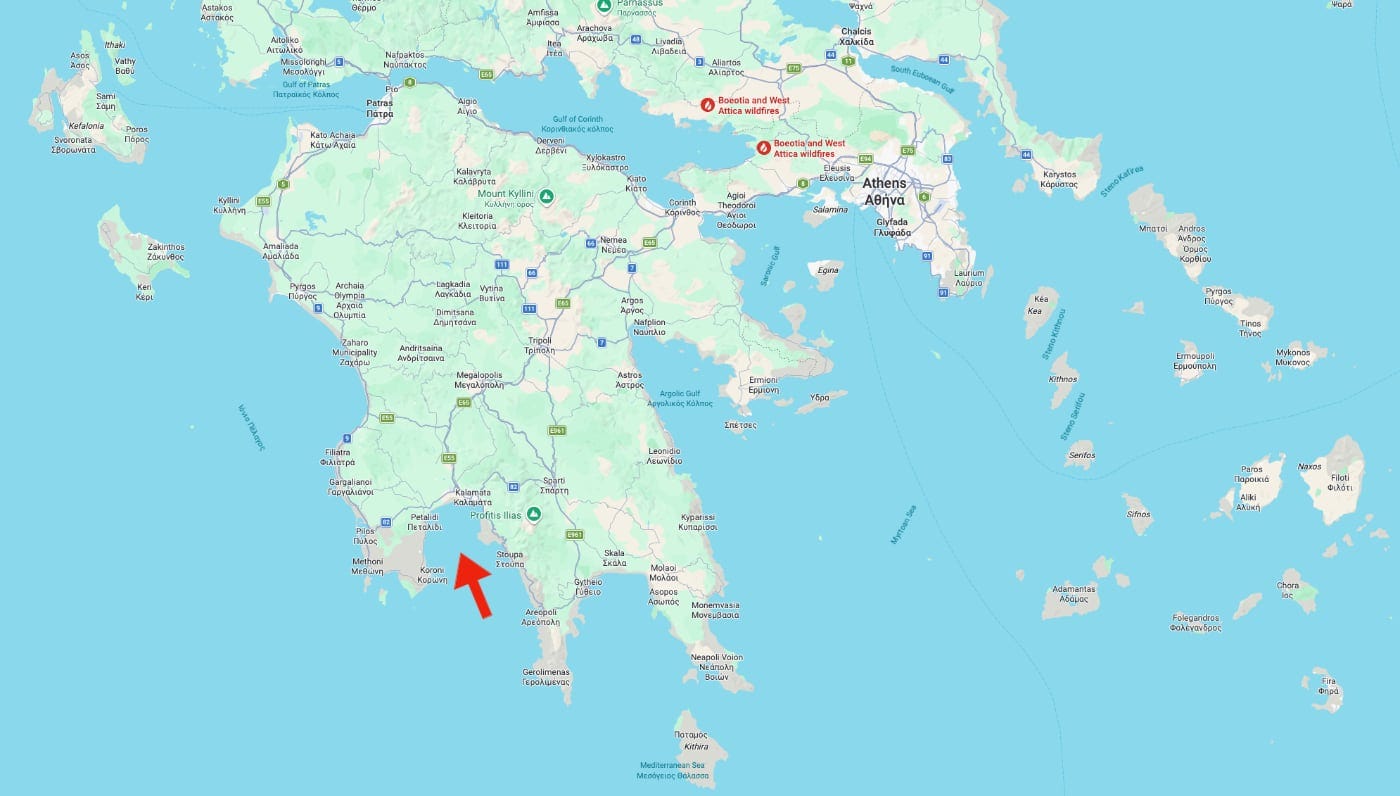
An early cheap flight on Jet2 from Edinburgh to into Kalamata had us breeze through customs and we were on the boat for a late lunch.
From there we took our time exploring Petalidi, Koroni and back to Kalamata where a few of us headed inland to Mystras and modern Sparta.
A highlight for me was boat life and how incredibly easy it was to switch off.
Very little matters on a boat. Outside of the obvious weather, wind, sea and bearing. And most of that is out of your control.
With no laptop and few demands from the outside world, I was blissfuly far away from unfinished projects, household chores and the usual distractions that take up my week. I only had to respond to what was in front of me.
With no sense of feeling like I needed to achieve something, a laid back curiosity was left to wander and I’d happily just stare at the sea, or scan the horizon for boats and wildlife.
There’s something psychologists call ‘soft fascination’ which describes how natural environments can hold our attention with very little effort. Especially around water. You might also watch the clouds float by, or listen to the wind in the trees. This soft fascination is interest without effort and gives our more intense ‘directed attention’ a chance to recover.
And now while still feeling pretty chill days after returning… I’m inclined to agree.
One of the most interesting things I stumbled upon while away in Greece was not Sparta or the UNESCO heritage site of Mystras, it was what I discovered at the toilet block in the Kalamata marina.
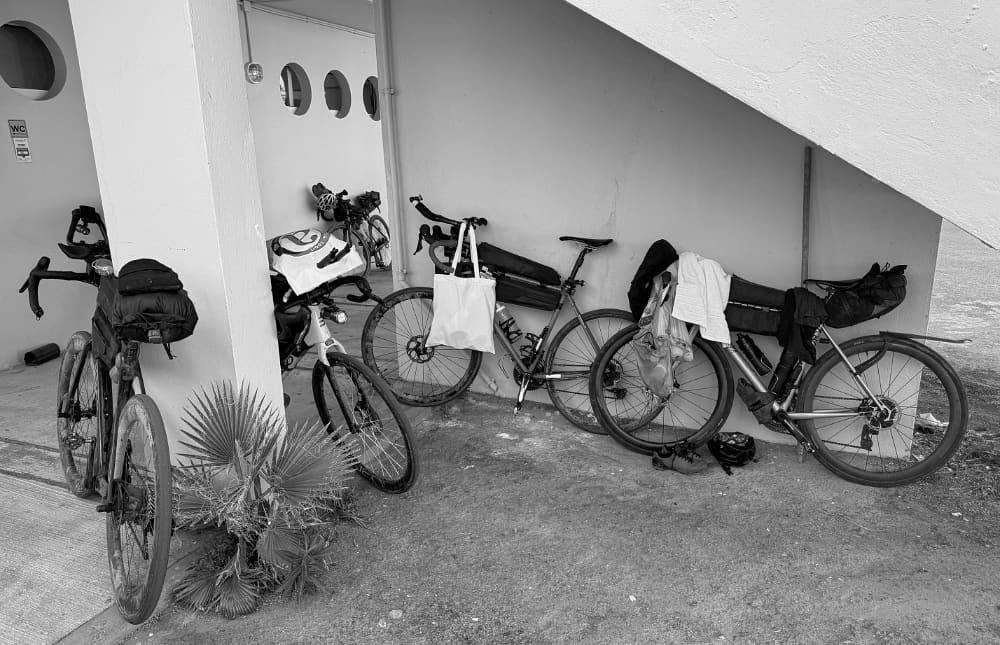
On stepping over a couple of sleeping bodies outside the loo, I spotted a few unattended high spec bikes leaning on walls. Each of them seriously kitted out for bike packing. As it was over 35 decrees C in the middle of the day I already knew these cyclists were serious, but it was only on chatting to a few did I realise the extent of their adventures. It turned out that the exhausted bodies on the floor had just completed possibly the hardest bike race in the world.
The Transcontinental Race (TCR), organised by Lost Dot, sounds insane. This is the twelfth edition of the now infamous self-supported ultra-endurance cycling race and this year it stretched from Trondheim in Norway to our toilet and shower block in Kalamata, Greece. A distance of approximately 4,900 kilometres.
Finishing before the cut-off time seems superhuman in itself, so I’ve no idea what level of fitness and mindset it takes to actually win it.
Self supported means no support vehicles, or team cars and no family or friends handing you food or booking you accommodation along the way. Your running time starts in Norway and stops at the finishing line in Greece. Everything is on the clock. Riders have to decide when to eat, where to sleep and which route to take between a handful of compulsory checkpoints. They carry everything they need or buy it along the way.
I felt so lucky to have been to be moored in Kalamata as the first riders rolled across an invisible finish line just a short walk from our boat.
Visually, as these were some of the first, it was a very understated finish. It started with just a few riders clapping a finisher and handing them a cold beer.. But then I saw this family arrive with some bunting just before welcoming their loved one.
I can’t begin to imagine the sense of accomplishment after having completed this gruelling route.
For example, the winner Robin Gemperle reached Kalamata in 10 days, 8 hours and 55 minutes. His chosen route came to about 4,900 kilometres, Meaning he averaged around 470 kilometres (292 miles) every day for more than ten days. That’s roughly the equivalent of riding from London to the Scottish Borders every single day.
Even allowing for four or five hours of sleep each night, he’d still have spent close to 19 hours a day on the bike, at an average speed of well over 25 km/h. And that’s across mountain passes, gravel tracks and in some of Europe’s hottest temperatures.
Mind blown.
At dinner that evening I snuck away from the family and grabbed the first cyclist I saw. It just so happened to be Tim De Witte who came third in the 2025 Transcontinental Race and this year was seated 9th. He finished in 11 days, 10 hours and 33 mins due to strange pain for a portion of the ride. After adjusting his saddle by 2mm the pain stopped. He told me that if he’d figured that out sooner he’d have finished much earlier.
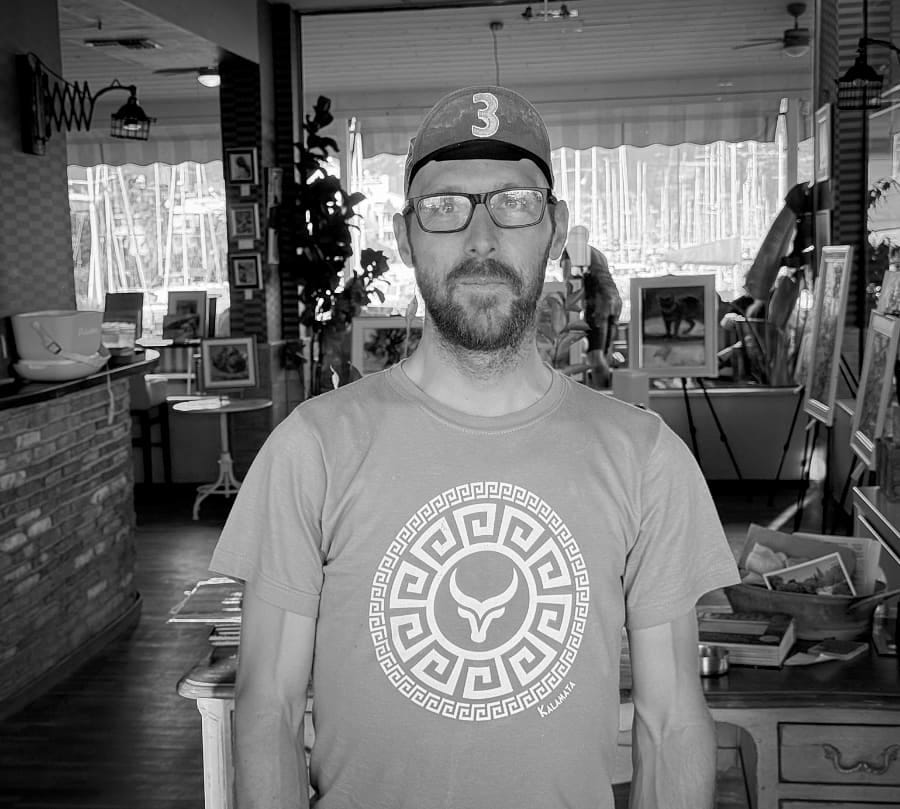
Tim managed to survive on 3.5 hours sleep per night and on one day [checks notes.. and check again] he rode 674 km (419 miles) in a 24 hour period.
He just looked like a normal human to me.
The race finishing party happens tomorrow night in Kalamata. Massive kudos to all those who took part in this incredible cycling event.
More details here on the Lost Dot website here.
I must say I'm inspired. Although having not ridden properly for a little while I’ll certainly pace myself. Tomorrow I’m hoping to ride from my house to the local brewery… without putting my feet down.
#TheSeen
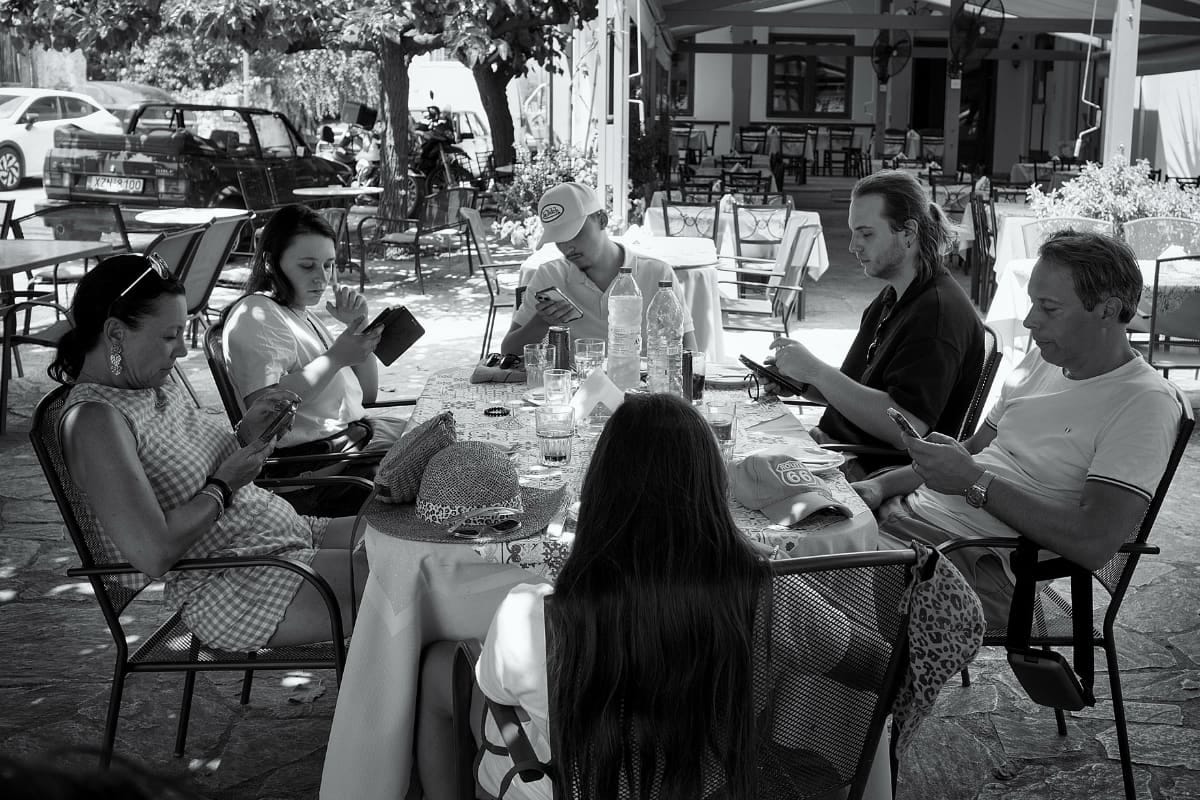
If you look at the picture at the top of this dispatch, you might say it’s the opposite of what environmental psychologists call soft fascination. I’m making assumptions about what each person in the image is thinking or feeling, but the visible behaviour suggests that everyone’s attention is directed away from the trees, the shade, the conversation and the world around them. Of course, they could all just be checking the menu before enjoying a long lunch together.
The image above and some other ones linked on Flickr behind this montage below were taken with the Ricoh GRIV Monochrome. But the bulk of the images not shared here of family having fun etc were taken on my phone.

#TheWords
Thank you to Amanda for linking to this Facebook post in the Documentally Discord. It’s one of a few I’ve seen protesting Substack’s decision to add an AI text detection tool.
The essay repeatedly argues that the tool behind it made by Pangram cannot prove authorship because it only analyses the finished text. That’s true.
But most companies making these tools don’t claim they can prove authorship. They claim they can estimate the likelihood that a piece of writing resembles AI generated text.
I found myself wondering why the writer Genny Harrison focused almost entirely on why the tool falls short, rather than acknowledging why platforms and publishers are interested in AI detection in the first place.
I’m also not sure whether the article was deliberately written in a style that resembles AI to make its point, or whether, by running it through CopyLeaks and getting a 100% AI score, I’m inadvertently proving the author’s argument. [scratches head]

One hundred percent does seem a little enthusiastic. That said, the piece has many of the characteristics that these detectors flag... a succession of punchline endings... a highly regular structure and a predictable rhythm. The Pangram tool Substack uses also flagged it 100% AI and 0% human.
That aside… I suspect Substack introduced this feature largely to help identify automated newsletters, AI-generated spam, fake submissions and other forms of AI slop.
I don’t think it’s fair to dismiss AI-assisted writing altogether. It can help people articulate ideas they might otherwise struggle to put into words, especially if they’re dyslexic or writing in a language that isn’t their own. There’s a big difference between using AI to help express your own thoughts and asking it to do the thinking for you.
But back to the Substack ‘Scan for AI text’ button... despite all the enshittification, feature creep and bloat that seems to affect most platforms in the end, I’m inclined to side with Substack on this one.
#TheHeard
I’m really enjoying the Lost Dot podcast and am currently on day 5 working through all the episodes. It’s really well done and I love the insight into those incredible riders who have taken on this gargantuan challenge.
I have been going through some old todo lists and found a reminder saying “Check out FairCamp”. Turns out faircamp.org is a simple static site generator for audio producers. I think I was hoping to host all my podcasts on one site. I’m now thinking this could be good for #AudioMo (Audio Bloggers Month.)
#TheConsumed
In the airport on the way home I got excited by what looked like an opportunity to taste some whisky.
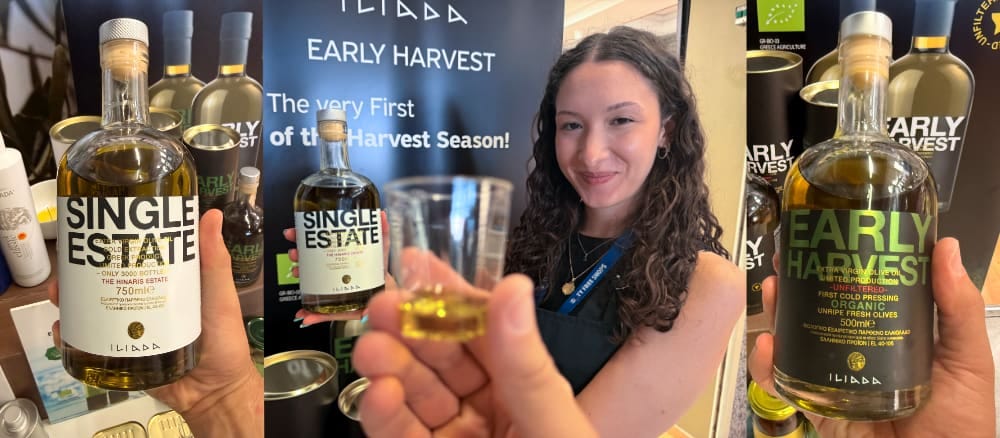
It turned out to be olive oil. Tasty olive oil, but I doubt I'll be coughing up the £36 needed for a bottle.
Inside the long AI powered quest to perfect the pringle . [Via Numlock.]
#TheThings
Should you be looking into some inspiration for your next bike, Andy Dodd, the comms manager at LostDot.cc pointed me to the ‘Riders Of’ section on Bikepacking.
Researchers in Cambridge have figured out an ‘easy’ way to convert plastic waste into hydrogen.
#TheLinks
More on Mike Hall, the founder of the Transcontinental Race, who tragically died in a cycling accident in 2017. Today, Lost Dot continues the race he created.
After a wolf escapes a zoo, a man is facing 5 years in prison for creating a fake ai sighting.
Feel free to add yourself to the Documentally community map?
This week’s accidental digital detox happened simply because I filled my time with other (more interesting) things. This article comes to a similar conclusion.
Covert data storage tricks.
Ancient history has an uncomfortable habit of describing the present.
Some of my other places include these… Supporting subscribers also get access to a Discord server. Message/email/phone me for a link. 👍🏽
#TheThanks
Thank you very much if you are one of the few who like, share and link to my posts. Please pass this one to any cyclists you know. I’m sure it all goes some way to getting the word out to any curious folk who might find something of use here.
And special thanks to those supporting subscribers who pay a small amount every month and support my time here. You really do keep it going, thank you. ♥️
If you are in a position to be able to pay a little to keep these words, ideas and curation happening, please consider an upgrade by clicking this button…
Or if you prefer a random hat tip you can do that via PayPal
Remember you are supporting a human doing manual work with their brain.
The sun is out here and it’s a very comfortable 20 degrees C. I’m off to catch up with outdoor projects. ..After I go pump up the tyres on my bike.
Have a great weekend!
“A boy told me
if he roller-skated fast enough
his loneliness couldn't catch up to him,
the best reason I ever heard
for trying to be a champion.
What I wonder tonight
pedaling hard down King William Street
is if it translates to bicycles.
A victory! To leave your loneliness
panting behind you on some street corner
while you float free into a cloud of sudden azaleas,
pink petals that have never felt loneliness,
no matter how slowly they fell.”― Naomi Shihab Nye
Restore.
See you out there.
Over…